Equipment Rental Agreement Template PDF Template
Stop searching and find out why people love the ease of creating beautiful and legally compliant Equipment Rental Agreement Template PDF with PDFSimpli.
Stop searching and find out why people love the ease of creating beautiful and legally compliant Equipment Rental Agreement Template PDF with PDFSimpli.

[toc] Whenever a lender of any kind allows a person to lease their assets, they involve themselves in a certain amount of risk. The level of risk will vary depending on the asset and the person leasing it. Most commonly, you’ll find lenders leasing houses and vehicles. But lenders can also lease equipment. Construction companies will sometimes need certain equipment for one-off jobs, as do renovation teams.
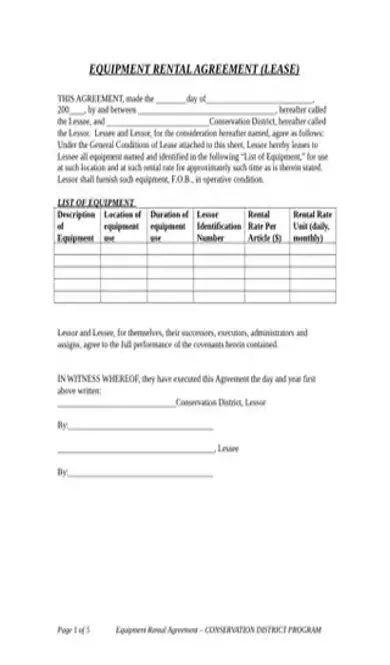
[pdf-embedder url=”https://cdn-prod-pdfsimpli-wpcontent.azureedge.net/pdfseoforms/pdf-20180219t134432z-001/pdf/equipment-rental-agreement-template.pdf”] The equipment rental template is a basic template for a rental agreement. It provides the basic information that you need to draw up a rental agreement, but it leaves blanks wherever there are potential variables. You’ll fill the form out by typing the correct variables into their respective blanks.
A template like this is ideal because it’s extremely versatile. Many different kinds of equipment can be leased using this format. In the majority of cases, people think about heavy-duty equipment being leased to construction crews and renovation teams. But people might also lease their gym equipment out to another person or business.
When the rental agreement is filled out, the lender and the leaser can go over the lease point by point. It’s important that all parties be on the same page regarding said lease. The complexity and included stipulations of the lease will also vary depending on the length of time the equipment is leased for. Some companies might lease equipment for several months or even years, while others might only need the equipment for one day or one week.
A rental agreement is a binding contract. By using the template, you can make sure that you’ve covered all your legal bases by filling in all of the variables. You don’t have to worry that you’ve forgotten important information. If you’re still not sure about the legality of the contract, though, it doesn’t hurt to have a lawyer double-check it. They can make sure you haven’t missed anything important with regards to the language and terms.
There are two main parties involved in an equipment rental contract. The first party is the individual or business that owns the equipment. The second party is the individual or business who is leasing the equipment. An equipment rental contract can be used by anybody who is leasing equipment of any kind. It doesn’t even need to be heavy-duty.
In cases where the businesses are doing the renting, an individual must act as the representative of their business to file the paperwork.
For the most part, the owner of the equipment will be responsible for completing the form. However, the lessee will have the opportunity to go over the entire contract with them before they sign. Additionally, the lessee will have the opportunity to ask for clarifications about any points they don’t understand or didn’t agree to.
A rental agreement does more than just note the amount of rent a person pays. Rental agreements are legally binding contracts. They’re designed to protect both the lender and the leaser. You should take advantage of the opportunity to use the agreement to preserve your equipment’s value and limit your own potential liability.
Forms will contain the standard information you’d expect: descriptions of all of the pieces of equipment, including their condition upon release to the leaser; the length of time the leaser plans to use the equipment; the dates at which operation will commence and conclude; the amount the leaser is paying for the equipment; and whether the leaser has given any consideration to a lease-to-own clause.
But they can also contain other information for your peace of mind. These contracts are a way of establishing rules regarding which parties are responsible for what, and how your equipment can be treated. You can implement clauses noting the following:
Places where the equipment can be used, along with ways it can be used
Whether the lender or renter is responsible for the maintenance and repair of their rental items
Whether the equipment rental requires a damage deposit
Whether outstanding rental balances will have interest added, along with the interest rate
If the renter intends to use the equipment for a long time, you should strongly consider adding an option to purchase clause. This gives the renter the right to buy the equipment when their leasing period expires. The rental agreement can be used to establish your purchase price or to indicate that you’re open to price negotiations after the lease ends.
The lender and the renter will both lack important legal protections. You’ll have no indication of how the equipment can be used, what condition it was originally in, and which parties are responsible for different aspects of maintenance. All of this information must be put down in writing on your original agreement, because this contract is your first go-to document if a dispute arises.
Provide the name of both the lessor and the lessee.
If any unusual terms are used in the agreement, add them to the Definitions section.
Write down detailed information about each piece of equipment being rented. This should include its manufacturer, make, model, what it visually looks like, the year of manufacturing, the purpose the equipment serves, and the weight of the equipment. You should also take note of the condition the equipment is in, taking down information about any scratches and damage that existed prior to the tenant’s renting.
Write down your guidelines on how the equipment can be used, in what places you can use it, and what the consequences are for failing to adhere to these rules.
Write down the agreed-upon rent payment, the interval between payments, and whether you’ve given the buyer a lease-to-own option. If a security deposit was required, make sure you note that as well.
Write down guidelines on which parties are responsible for maintenance and upkeep while the renter is using the equipment.
Write the dates that the lease begins and ends.
If it’s any kind of equipment that wouldn’t be better suited by a vehicle lease, you can use this template for it.
Any information about potential financial consequences should be placed with the financial information, like the rent section.
Yes. You need this form to create the legal contract between the lessor and the lessee. Failing to complete this form will result in a legal mess.
Select Language





© 2026 , WorkSimpli Software, LLC. All rights reserved.