Licensing Agreement Template
Stop searching and find out why people love the ease of creating beautiful and legally compliant Licensing Agreement with PDFSimpli.
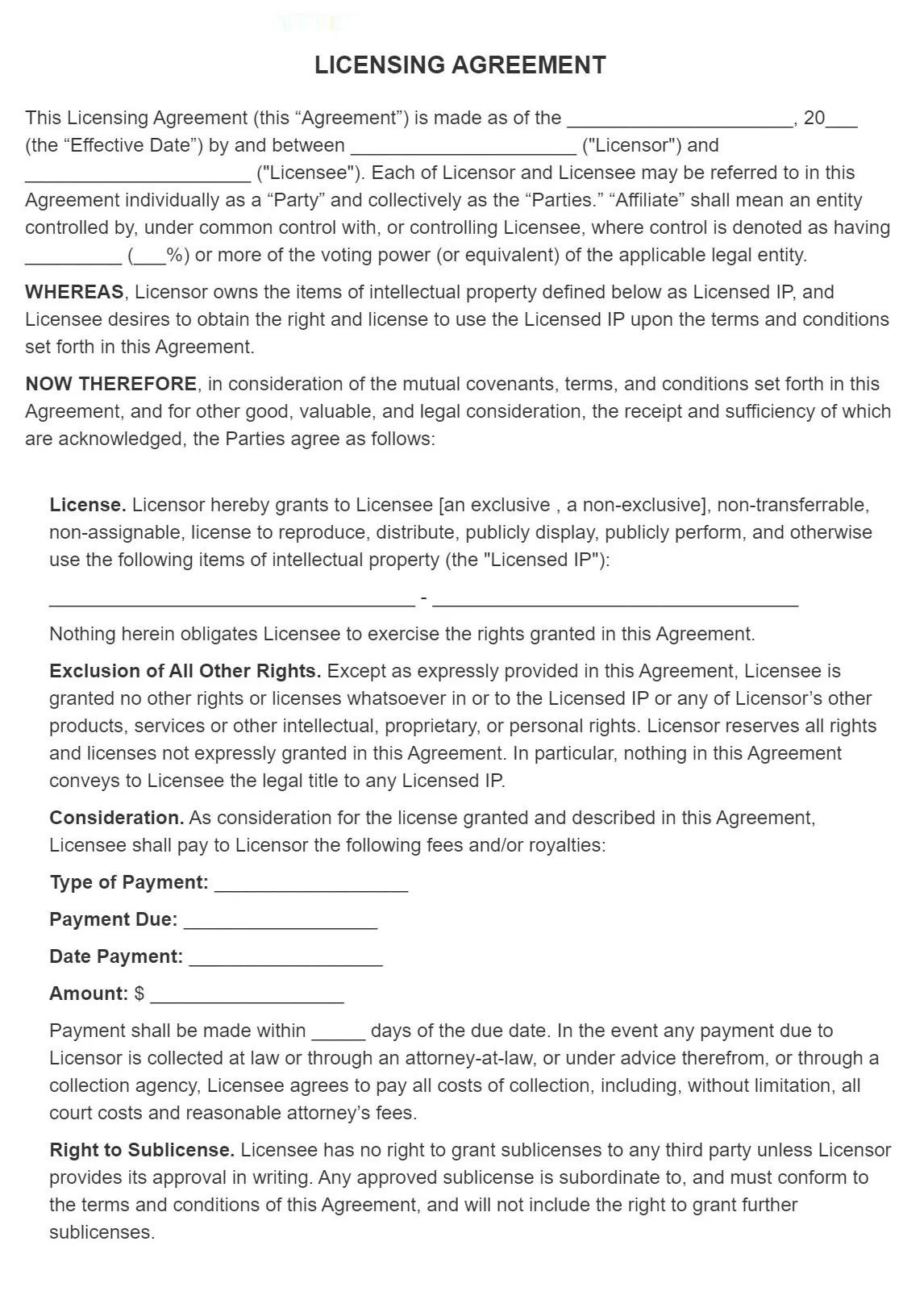
Stop searching and find out why people love the ease of creating beautiful and legally compliant Licensing Agreement with PDFSimpli.

Pick from the colors and templates below
A licensing agreement lets a licensee use intellectual property. Intellectual property (IP) is any work that is not material, such as a copyright, patent, trade secret, design, geographical indication, or trademark. A licensing agreement can be exclusive or non-exclusive. An exclusive license grants the licensee the exclusive right to use the IP for a specified period of time. Non-exclusive agreements let licensees use the IP, but the licensor retains control of the IP. Sole licenses are used when the licensor wants to grant a licensee exclusive rights but still retain the right to use the IP. Licensing agreements can also be known as a trade secret license agreement, patent license agreement, trademark licensing agreement, intellectual property license agreement, and other names.
The agreement itself describes the licensed material and how it can be used. It must also specify the type of fee. There is almost always an issuance fee paid upfront or over time. Other fees include royalty and milestone payments, as well as renewal fees. Licensing agreements may also contain stipulations about the IP such as what information is confidential and what standards of quality the licensee must meet. The most recent licensing agreement is the valid one, even if it contradicts prior agreements.
Licensing agreements are commonly used by authors to allow screen or video game adaptions of their stories. Owners of slogans, designs, or photographs can also use them to make a profit from their creations. Another real-life example is a patent holder licensing the use of a part she designed to a company that wants to use it in mass production. Software companies also use a derivative of a licensing agreement called an End User License Agreement or EULA to limit the ways in which users can utilize their programs. Licensing agreements allow individuals and entities to make money on otherwise intangible assets.
Anyone who wishes to protect an intellectual property should use a licensing agreement. It is very difficult to make money without one, and there can be large financial and emotional consequences for not using one. If another individual or company uses an intellectual property without an agreement with the owner, they risk litigation and irreparable harm to their reputation. The owner of the IP can also incur large costs in the form of legal fees and public scrutiny of the decision to sue. It can be particularly embarrassing if the owner of the IP loses the suit. In this way, licensing agreements not only protect profits but also the licensor’s control over the intellectual property.
Licensing agreements usually include the same common elements. Additional elements will be related to the type of intellectual property and the goals of the licensee and licensor. Licensing agreements can also vary by state. The most commonly included parts are listed below.
Before you start writing the agreement make sure you have all the necessary information. Double check that the information for the licensee and licensor is accurate and spelled properly. It is also important to ensure that both parties have agreed to the terms and are ready to sign. It would be unfortunate to write the document with inaccurate information and then have to scrap it.
Software can make the process smooth or frustrating, depending on its quality. Good software should be easy to use and get out of your way so that you can focus on the important details. This is especially important for legal software, as the smallest mistake on a legal document can cause big problems. PDFSimpli is an example of good legal software. Our templates are professionally designed to help guide you through the process of creating a functional and aesthetically pleasing document.
Once you have chosen a template, it is time to fill it out with the necessary details. PDFSimpli highlights the places that need to be filled out so you can jump through and input the information. You can also select, delete and rearrange the document according to your specifications.
It might be tempting to jump right to printing, but every writer makes mistakes. Double check the document for any errors that spell check might have missed. These can include grammatical errors as well as misspellings of names and other details. One of the best ways to catch typos is with a second set of eyes or by reading it aloud. It can also help to read the document backwards.
When you have double checked and triple checked the document, you can finalize it. PDFSimpli has flexible options. You can save it, download it for printing or even send it for eSigning. Consider keeping a back up in case the original is lost or destroyed.
How you negotiate a licensing agreement depends on the type of intellectual property and the context within which you are negotiating. The author of a bestselling series will have a stronger position than one with less sales. If the licensee is very likely to profit, the licensor has a much stronger position because the licensor can offer a deal to someone else. This is why negotiations between toy companies and popular movie franchises can be so competitive.
If a party violates the agreement then the agreement is considered void. The guilty party may also be responsible for damages. If one party suspects another of wrongdoing they can sue them. Lawsuits can start either from breech of contract or missed royalty payments. In the case of royalties, small differences in percentages can add up to staggering amounts. Companies have been sued for millions of dollars over missed royalty payments and violations of licensing agreements.
Select Language





© 2026 , WorkSimpli Software, LLC. All rights reserved.