Quitclaim Deed Nevada PDF Template
Stop searching and find out why people love the ease of creating beautiful and legally compliant Quitclaim Deed Nevada PDF with PDFSimpli.
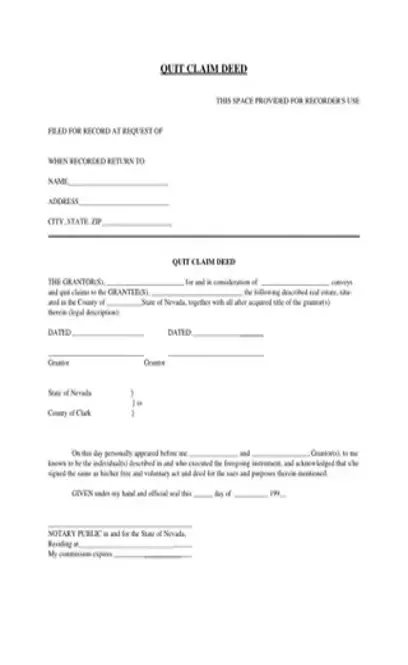
Stop searching and find out why people love the ease of creating beautiful and legally compliant Quitclaim Deed Nevada PDF with PDFSimpli.

[toc] A Nevada quitclaim deed is used when a trust, entity, or individual person wishes to transfer their real property. The deed is unusual in that it does not include a warranty. Instead, the seller simply transfers their property rights to another person. You’ll most often find this form used when a close situation is taking place, usually between family members or other related entities. You have to first make sure you are filling the correct quit claim deed form. This type of deed should be fully thought through before filing it to the county as you will be relinquishing your property ownership to the transferring property. We recommend you get the proper legal advice before going through with the process of transferring ownership. PDFSimpli offers a sample quitclaim deed that you will be able to edit as you like with user-friendly software.
Property can be held by a variety of different entities, including individual people, businesses, and trusts. The Nevada quitclaim deed is a simple way of transferring real property between entities. It stands apart from warranty deeds because it doesn’t include any warranty. The main goal of the seller is to transfer their property rights to another person. These rights might range from full rights and title to no rights at all.
Oftentimes, this form will be used between business partners or family members. The party transferring their property rights is referred to as the “grantor,” while the “grantee” is the recipient of the property.
Quitclaim deeds shouldn’t be used by strangers. When this form is used for real estate property transfers, it’s generally done between two close parties. The ease of use is good for people who want to transfer property to someone they know and trust. But quitclaim deeds would have drawbacks when used between strangers, because they don’t provide any warranty or guarantee to protect the grantor.
There are a number of potential scenarios that can employ a quitclaim deed to great benefit. Some examples include:
Amicable divorces wherein real estate must be transferred from one ex-spouse to the other since they will no longer jointly own it
Amicable divorces wherein real estate must be transferred from one ex-spouse to the other since they will no longer jointly own it
Real estate transfers between close family members, in which there is no asking price for the property
Real estate transfers between close family members, in which there is no asking price for the property
The transfer of rights to a timeshare
The transfer of rights to a timeshare
The shifting of real estate properties from an individual to a corporation or business
If you want an easy way to transfer property between two parties, and you don’t intend to go through the hassle of a property sale, a quitclaim deed has you covered. It painlessly moves rights from the grantor to the grantee without unnecessary paperwork and complicated legal contracts.
The main goal of the quitclaim deed is convenience. If you choose not to use it for a property transfer, you can use a warranty deed instead. This comes with an assurance that if anything goes wrong, the grantor is protected by the warranty. However, quitclaim deeds take a shorter amount of time and energy than warranty deeds.
If you intend to file a quitclaim deed, you’ll need to get in contact with the Recorder of Deeds. This county position is filled in every county across Nevada. Go to the county office in which the property resides, even if you don’t live there yourself. You’ll need to inquire about any special requirements that the county has regarding quitclaim deeds.
After you understand your county’s rules and regulations, you need to get a quit claim deed. Fortunately, we provide samples that can be used in legally binding contracts. If you want to use this PDF, you should print it or type the required information. Alternatively, a lawyer can draft the deed. Just make sure that the online PDF is compliant with the formatting requirements in your county.
The very top of your document should be devoted to important, required information. The following facts must be written:
The parcel number for the assessor, which can be found by asking the Recorder or looking at the real estate’s current deed
The parcel number for the assessor, which can be found by asking the Recorder or looking at the real estate’s current deed
The name of whoever is filing the deed, otherwise known as the grantor
The name of whoever is filing the deed, otherwise known as the grantor
The address to return the deed to after it’s officially recorded
Document whatever address should receive taxes for the property. Any quit claim deed without tax mailing information will not be eligible for filing.
With all of this basic information out of the way, you can now identify the involved parties. The grantor or grantors are conveying the property to the grantee. In exchange, the grantee is giving them money. This sum is called “consideration” in legal documents. Include the address of both the grantor and grantee, the fact that consideration was exchanged, and the address of the property.
Use your current deed to find a description of the property. Properties have legal descriptions, which you can insert word-for-word onto the quit claim deed. Your next step will be to find the person who created the property’s legal description. This is generally the surveyor who examined the house before you bought it. Their name and address should be included in your original deed is the first legal document bearing your property’s description.
The deed needs to be dated with the day you fill it out. It also needs to be signed at the notary public’s office by both the grantor and the grantee. Make sure you leave room for the notarial seal to be placed. Depending on your county, you might need to write an additional affirmation.[pdf-embedder url=”https://cdn-prod-pdfsimpli-wpcontent.azureedge.net/pdfseoforms/pdf-20180219t134432z-001/pdf/quit-claim-deed-nevada.pdf?sv=2018-03-28&si=readpolicy&sr=c&sig=MXHnWmn0sXNXztiU%2Bugk2d7DV7KBCOuXF3oBMx0EeEw%3D”]
For the most part, you shouldn’t face any fees to file the deed. The main cost will be in any consideration that the grantee pays the grantor or grantors.
When you’re transferring rights to real estate property, it’s always best to have a lawyer oversee the transaction. With that said, as long as the attorney doesn’t find any problems with the document, and said document isn’t missing any information, the deed will be a legally binding transfer of property rights.
There are some cases in which the grantor is still making mortgage payments when they file the deed. In these cases, the grantor continues to be responsible for paying off the mortgage, while the grantee holds the title to the property.
Select Language





© 2026 , WorkSimpli Software, LLC. All rights reserved.