Snow Removal Contract PDF Template
Stop searching and find out why people love the ease of creating beautiful and legally compliant Snow Removal Contract PDF with PDFSimpli.
Stop searching and find out why people love the ease of creating beautiful and legally compliant Snow Removal Contract PDF with PDFSimpli.

[toc] For any commercial property owner, snow removal is probably a big concern. You might not be worried if you live in the South, but regions like the Northeast and Midwest can guarantee that winter will be rough. It can be tough to predict the costs of snow removal, not to mention the potential damages that large snowfall incur. A snow and ice removal provider will often let you sign on early. This is what you need to know about these contracts.
One of these removal contracts is generally struck between a commercial property owner, and a snow and ice removal service. The type of contract that works best for you will vary depending on your needs. If you use a Time and Materials contract, you’ll only need to pay for whatever services you’re given.
If above-average snowfall occurs, though, you might end up paying more than you expected to. You should also consider whether you want to contract by the hour. If hourly contracts are done, you need to be sure the removal team is qualified for the job. If they have improper equipment or experience, they might take longer than necessary, resulting in a higher bill for you.
Another option is the per-inch contract. This type of contract is also called a Per Event contract. This contract lets you place a price depending on the accumulation levels of the snow. You’ll pay for whatever services you need, but you’ll be given some added certainty about the cost based on the snowfall. Like the other contract, though, this has the potential to be expensive if the snowfall is heavier than average.
Your next option is the Per Occurrence contract. This lets you control the time frame when services will be administered and the cost of each service visit. Every individual operation will have its own price.
A Fixed Fee contract is paid before the start of the year. You’ll pay the same amount for the removal services, no matter how much snowfall there is per year. This is a good investment when you live in areas that have recent larger-than-average snowfalls. To calculate the price, the company will generally calculate their probable time spent based on average snowfalls and the services necessary for your property.
If you’re a commercial property owner living in an area that often has snowfall, you’ll want to invest in a snow and ice removal contract. When you engage in this contract, you know that a snow and ice removal company will help take care of your property in the event of an unexpected snowfall. It’s essential to strike these contracts ahead of time, as failing to do so will result in added fees and a difficult time finding a non-busy removal company.
It’s best to sign your snow removal contract at the beginning of the winter season, rather than waiting. Such a contract will cover you through the duration of winter. You might also want provisions for it to last through spring, especially if you live in particularly northern regions.
If you don’t contract with a snow and ice removal services company, you’ll be responsible for clearing the snow from a commercial property yourself. You’ll need to rent a plow and either know how to use it, or hire a driver who does. You’ll also be responsible for snowblowing or shoveling the sidewalks and steps. You’ll have to put down salt and break up the ice.
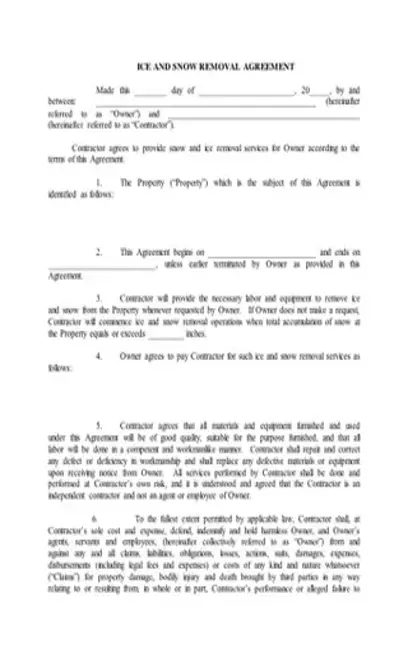
Write the date of the agreement, along with your name. The managing agent of the property will also need to provide their name.
Write the name of the property and its street address. Then give the contact name for the contractor, the contractor’s address, the contractor’s phone number, email, and after-hours number. Contact the contractor to receive their taxpayer ID number. The recorded commencement date is the time at which the contract starts, while the termination date is the time at which it ends.
You’ll need to provide your snow removal guidelines. Modify them to suit your property’s needs. If you have sidewalks, you’ll need these de-iced; parking lots will need to be plowed.
Make sure you note any insurance requirements. Different states will have different requirements for their contractors. You should, at the very least, make sure the contractor has a liability insurance policy.
The property’s plan will make up the next part, explaining what services are necessary and giving a map of the property.
The final part of the contract will be the pricing. Your prices will vary depending on the type of contract you enter into. If you pay by the hour, you’ll denote an hourly rate. If you’re paying one price for the whole season, you’ll denote this as well.[pdf-embedder url=”https://cdn-prod-pdfsimpli-wpcontent.azureedge.net/pdfseoforms/pdf-20180219t134432z-001/pdf/snow-removal-contract.pdf”]
Larger properties will have more work and more challenges. Snow and ice removal services will generally factor the size of the property into their pricing requirements.
This contract should be a legally binding document between yourself and your removal service. If you’re worried about the legality, you can have an attorney double check your finished PDF.
You’ll need the owner of the property to sign, the property manager to sign, and whatever spokesperson represents the removal company to sign as well.
Select Language





© 2026 , WorkSimpli Software, LLC. All rights reserved.