Standard Residential Lease Agreement PDF Template
Stop searching and find out why people love the ease of creating beautiful and legally compliant Standard Residential Lease Agreement PDF with PDFSimpli.
Stop searching and find out why people love the ease of creating beautiful and legally compliant Standard Residential Lease Agreement PDF with PDFSimpli.

[toc] When you agree to rent a property or part of a property, you and the landlord will enter into a residential lease agreement. The standard version of this will take down your rent information and the personal information of the involved parties. Lease agreements for commercial businesses are more complex, but for residential purposes, the contract can be boiled down to the basics.
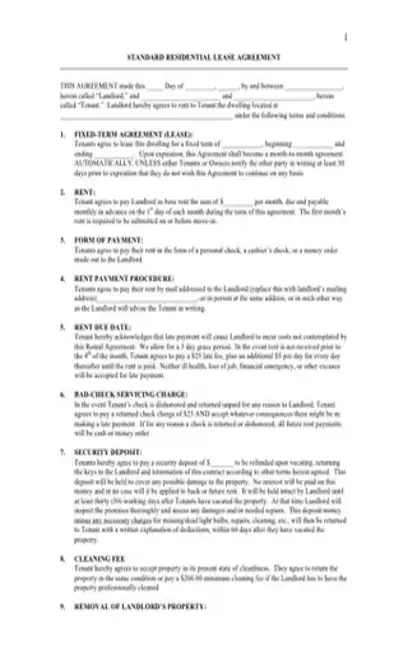
When a person rents a residence from a landlord, a residential lease agreement is their contract put in writing. Every negotiated term should be included on the agreement. These documents can also be called landlord-tenant leases or apartment rental agreements. The tenant generally signs the contract at the beginning of the rental term, and the lease continues to be in effect until the end date listed in the agreement. Most leases will last for one or two years.
The goal of a residential lease agreement is to put down in writing all of the rules, regulations, and sums that have been negotiated between the landlord and the tenant. This helps mitigate the potential for confusion or misinterpretation regarding property access. The lease is also the main legal resource for both parties should any disputes arise.
This is an ideal form to use if you meet the following circumstances:
You are either renting a property from a landlord, or you’re renting a property to a tenant
The property is zoned for residential living, rather than commercial operation
You need to have your negotiated terms in writing for legal purposes and for your records
In any case where you rent a property, even if you rent from friends or family, it’s helpful to have a lease agreement as a reference point.
Typically, the rental agreement will be signed before the tenant moves into the residential property. Part of the rental agreement includes the prospective move-in date for the tenant. The lease will usually cover a predetermined time period. Most commonly, leases last for one year, but there are some that last for six months or two years. It all depends on the preference of the landlord.
There are generally consequences if you choose to break your lease early. Consequences of early termination should also be denoted in the lease. If you’re unsure about the terms being laid out, there’s no harm in having an attorney double check the contract to make sure the agreement is legal and safe.
Failure to use a standard agreement has potential ramifications for both the tenant and the landlord. For the landlord, a standard agreement will outline rules for the property, penalties for incurred damages, rent amounts, payment schedules, and the date the lease terminates. If the landlord doesn’t have these things in writing, the tenant has a legal means to say they weren’t aware of the terms, and therefore cannot be held responsible for them.
On the tenant’s side, the financial aspect of the agreement is important. You need to note down your agreed-upon rent payment to keep your landlord from changing it suddenly. Your agreement will also include any utility bills that you’re responsible for paying. If you don’t use a lease agreement, you have no physical proof that you reside in the apartment. You also have no way of enforcing boundaries or keeping your landlord from entering your space.
A leasing agreement is created for the protection of all involved parties. Using it will make you happier, safer, and less anxious.
Different lease agreement forms will have slightly different layouts. However, the basic information should remain the same across all of them.
First, there will be a description of the property. This includes the physical address, along with an itemization of any related assets like microwaves, dishwashers, and refrigerators. This description protects the landlord from theft upon the vacation of the tenant. It also protects the tenant by indicating that the landlord will take responsibility for these appliances.
The tenant’s name and signature must be featured on the form. If there are multiple adult tenants, every one of them must have their name and signature attached.
The duration of the lease must also be expanded upon. Most places will have you commit to at least one year, but you’ll make payments monthly rather than annually. There are some places that will rent month-to-month and accept the tenant’s vacation of the premises before a year has gone by.
The lease renewal period will be defined. If you have a month-to-month lease, you’ll generally have it self-renew unless the tenant or landlord gives an official notice of non-renewal. When a longer lease agreement is at play, month-to-month arrangements are usually used after the first time period is up. No matter what the terms, the document will outline both renewal and non-renewal procedures for the lease. You’ll also be informed of how much notice the landlord or tenant must give before a non-renewal.
Finally, the agreement should note the tenant’s security deposit and associated fees. Any money that the tenant pays the landlord outside of the rental contract is denoted in this section. This is also where rules for conduct and terms of the security deposit release will be written.[pdf-embedder url=”https://cdn-prod-pdfsimpli-wpcontent.azureedge.net/pdfseoforms/pdf-20180219t134432z-001/pdf/standard-residential-lease-agreement.pdf”]
Each tenant will have a copy of their signed lease, as will the landlord. The tenant can refer to the outlined rules if there’s ever an issue with maintenance or building management.
If you rent from immediate family members or close friends, you might be confident that your rent payments won’t change. For this purpose alone, verbal agreement is fine. But written leases serve more purposes than just legal protection. Your lease will serve as your proof of residence when you sign up for official documents like your driver’s license or voter registration card.
The standard information will remain the same, but leases can be modified to fit any unique circumstances. They aren’t an official government form, so their layouts are non-regulated.
Select Language





© 2026 , WorkSimpli Software, LLC. All rights reserved.