Last Will and Testament Template
Stop searching and find out why people love the ease of creating beautiful and legally compliant Last Will and Testament with PDFSimpli.
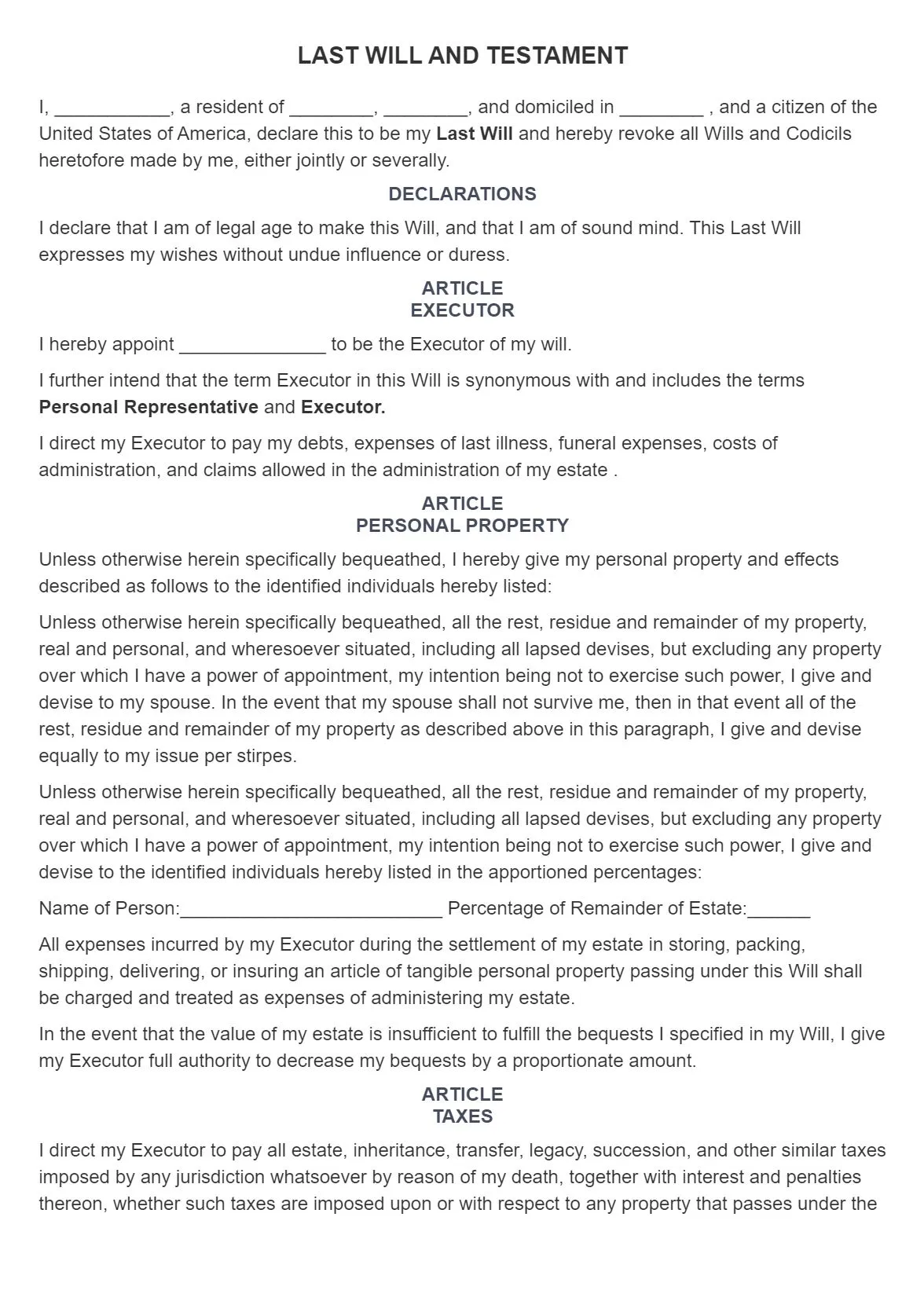
Stop searching and find out why people love the ease of creating beautiful and legally compliant Last Will and Testament with PDFSimpli.

Pick from the colors and templates below
Your last will and testament is a document that makes sure your wishes are honored and your assets go where you want them to after your death. Typically, the form names a specific individual as your will’s executor; it’s his or her job to make sure your will is carried out. The will itself names how your assets are to be divided, whether that’s property, money, or even your pets. If you have minor children, your last will and testament should also designate who will become their legal guardian(s) in the event that both you and your co-parent are deceased or otherwise unable to function as guardians.
There are several other reasons why it’s important to create a last will and testament. If you own a business, for example, you can use your will to protect it and make sure that it’s passed on to whomever you want. If you want some or all of your assets to benefit a specific charity or charities, you can use your will to make sure that happens.
Ultimately, the forethought you put into creating a last will and testament will make your death easier for your loved ones. No time will be spent haggling with each other, with lawyers, or with the probate court. While last will and testament laws vary from state to state, particularly in your will’s execution, the bottom line is this: If you have a will, what you say goes.
Your will dictates what should happen to your children, if you have any, and your assets after your death. More specifically, it covers:
• Guardianship, or who should raise your children in the event that both you and their other parent are deceased • Assets, which can be anything from your money to your great-great-grandmother’s ring to your beloved collection of commemorative spoons • Real property, such as a house or condo Should you wish to include real estate property in your will, it’s worth noting that most experts agree that you’d be wise to work with an experienced estate planning attorney to set up that transaction since it’s more involved than simply saying that your spouse should get your Camaro. In many cases, you might be advised to create a trust.
Writing a last will and testament benefits both you and your loved ones. For you, it grants the ability to provide for your friends, family, and favorite charitable organizations. You can name the legal guardian of your children and decide who gets your townhouse. You can set up trust funds or college funds for your children and grandchildren. If you don’t make these decisions, the state will.
For your loved ones, a will can save them from a time-consuming and expensive effort to resolve your estate. Even if your children aren’t quibbling over who gets what, state laws will likely require them to complete mountains of paperwork. If property is involved, their headaches – and the cost of probate and other legal hurdles – will skyrocket.
There are several things to think about and plenty of information to gather before you start writing your last will and testament.
Before you sit down to start drafting your will, round up the necessary information. Have you picked your executor? How about witnesses? Do you have a clear accounting of what you want to go where? While time-consuming, pooling this information together all at once will make putting it in writing much simpler.
While some individuals opt for physical paperwork in completing their last will and testament, many others prefer the convenience of creating their will online. With PDFSimpli, the process couldn’t be easier. Our last will and testament templates are color-coded to make identifying what you need to fill in or change a snap. Manual edits and additions are just as simple to make.
Fill in your form carefully. If you’re filling out your form online, remember that many online editors don’t allow you to save your work and return to it later for editing and revision. You’ll need to complete it in one take. With PDFSimpli, however, you can save your draft at any time. This lets you work at your own pace. Depending on the terms of your will and the number of instructions you wish to have carried out, this freedom to revise at your leisure before producing your formal document is extremely valuable.
When you finish your first draft, review it carefully to make sure you’ve included everything – and everyone – that you’d like. Now’s a good time to proofread for grammar and punctuation errors, too. Your final copy should be clean, clearly written, and professional.
When you’re happy with your document, save it and download it to your device. When you’re ready, print it out so you can get it signed by your witnesses. In most states, your will does not need to be notarized.
The executor of your will should be someone responsible and organized. He or she will be in charge of gathering your assets, paying off your debts and expenses, and distributing your assets. Your executor may have to make several decisions on your behalf, review a variety of records and resolve outstanding claims. In short, while your executor will be guided by the court, it can be a big job and one that involves plenty of logistics and financial matters. Take this into account when appointing your executor.
Neither felons nor minors can execute a last will and testament. Your executor must also hold United States citizenship. Many people choose to name an executor that is not a beneficiary in order to avoid any arguments or conflict of interest claims. That said, whomever you choose to carry out your will be overseen by the court, so it’s not like an executor who is also a beneficiary could revise the terms of your will to somehow grant them more benefits.
Both documents have their pros and cons. The main difference is that your will won’t kick in until your death. A trust, on the other hand, goes into effect as soon as it’s created. If you’re incapacitated, your trustee can assume control of your estate. Wills go through a probate process; a trust does not, which can save time and money. A will lets you appoint a guardian for your kids. A trust does not. A trust can save money on taxes and is private. A will, and any transactions resulting from it, are public record.
Select Language





© 2026 , WorkSimpli Software, LLC. All rights reserved.