Affidavit of Title Template
Stop searching and find out why people love the ease of creating beautiful and legally compliant Affidavit of Title with PDFSimpli.
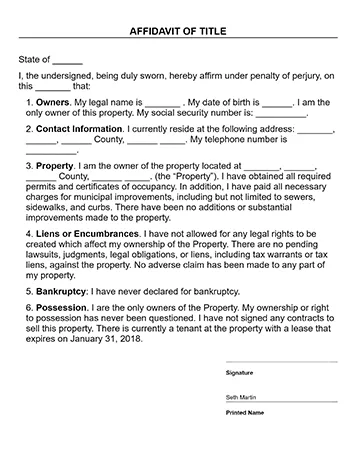
Stop searching and find out why people love the ease of creating beautiful and legally compliant Affidavit of Title with PDFSimpli.

Pick from the colors and templates below
An affidavit of title is a legal document that explicitly states that the seller in a real estate transaction owns the property in question and that indicates the status of any relevant legal proceedings. An affidavit of title may be used for any type of real estate including a single-family home, townhome, condominium, investment property or vacation home. The document does not distinguish between types of property.
The most important characteristic of the affidavit of title is that it is a legally sworn document, under oath, that the statements made in the document are true to the best of the signer’s knowledge. This means that the signer is risking the penalty of perjury if he or she attests to untrue statements. The document can help to ease any concerns that the buyer may have about the transaction.
Although the only necessary element of an affidavit of title is a statement that the signer legally owns the property, it is common to include statements about other facts surrounding the sale. This may be that there are no liens or unpaid taxes currently against the property. Similarly, it may indicate that no one else is currently buying the property. In short, the affidavit indicates that no one else could claim ownership of the property after the sale.
If you own something valuable, such as a house or land, you may need to prove that you own it before you can sell it. An affidavit of title can be used as a simple way to make a legally binding statement that you own the property. In other words, it is a way to address any concerns that the buyer may have about potential claimants to the property.
This is helpful because it can simplify the process of proving ownership. Rather than actually producing evidence that you own the property, you simply accept the legal ramifications of lying about it. Therefore, you can complete the process by seeing a notary public rather than going through a more complex legal process.
As a seller, you may want to use an affidavit of title to provide assurances to your purchaser. This may arise because the buyer wants clarification that you own the property and a free to sell it as you see fit. You may also consider providing this voluntarily if there has been some previous confusion around the status of the property.
If you are the buyer of the property, you may request an affidavit of title for the same reasons. Compared to examining all the documentation that proves the ownership and claims on a property, an affidavit of title can be an expeditious solution. It can also provide some legal protections in the event that someone else claims the property.
Although the specifics of an affidavit of title can vary from situation to situation, the majority of the document tends to be more or less the same. These are the elements of an affidavit of title:
The first step of creating your affidavit of title is to collect all the details you need. This will depend on your situation. It is a good idea to review the property title and any mortgage or other loan documents you may have for the property. Take the time to double-check the statuses of all relevant proceedings before signing your name to the affidavit.
Once you are ready to create the document, you should choose a software tool to work with. While it is possible to create your own affidavit, it is best to work from a template. PDFSimpli has a selection of fillable affidavits of title. They are easy to complete and you can edit the contents to fit the specifics of your situation.
After selecting a form to work from, open it in the PDFSimpli online editor. You can complete the relevant fields with your information. Additionally, you can edit the wording of the document. For example, you may add details about an easement on the property. You can edit on any device that has a browser and save to the cloud as you go.
Before you sign the document, make sure that it is completely accurate. Again, this is a legally binding statement that the contents of the affidavit are true. Therefore, it is imperative that you are completely confident about the details. Any untrue statement, even an unintentional one, could result in some significant legal difficulties.
Finally, you will be ready to sign the document. This needs to be done with a notary public. So, download or print the document (or save it for later) and bring it to a notary. There, you will need to show proof of your identity and sign the document in front of the notary public.
Your affidavit of title needs to include an identification of the property and the seller (you). It also needs to include a confirmation that you are the legal and sole owner of the property. If there are multiple owners, all of them must be mentioned on the affidavit. Additionally, it should confirm that there are no bankruptcy proceedings, liens, easements or other legal matters affecting the property ownership. If there are, you must include details in the affidavit.
No, an affidavit of title is not always necessary when selling a property. It is only necessary to provide assurances to the buyer that you are legally allowed to sell the property to him or her. However, if there are any concerns about the ownership, creating an affidavit of title is quick and the easiest way to prove ownership.
If you are the buyer of a property, you may request an affidavit of title in order to be sure that the seller owns the property and can sell it to you. You may consider asking for one regardless of whether you have any concerns about those facts. However, many buyers only request one when there is some reason to want confirmation.
Select Language





© 2026 , WorkSimpli Software, LLC. All rights reserved.