Hold Harmless Indemnity Agreement Template
Stop searching and find out why people love the ease of creating beautiful and legally compliant Hold Harmless Indemnity Agreement with PDFSimpli.
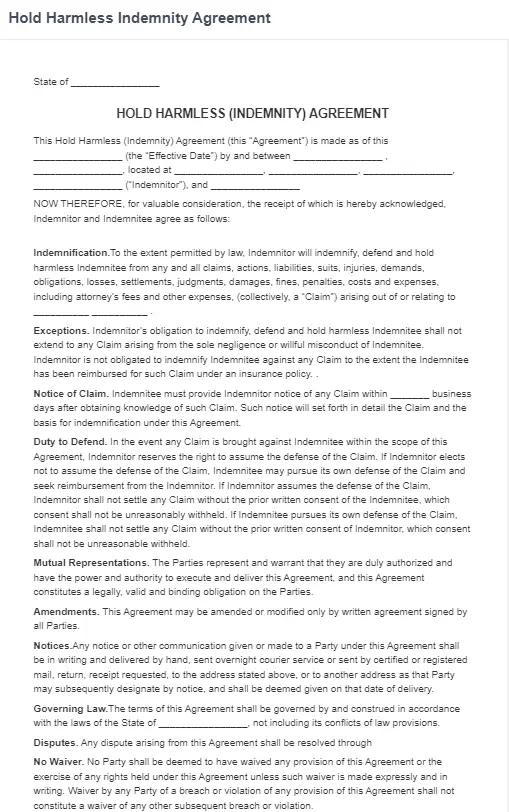
Stop searching and find out why people love the ease of creating beautiful and legally compliant Hold Harmless Indemnity Agreement with PDFSimpli.

Pick from the colors and templates below
A hold harmless (indemnity) agreement is a clause, often part of a contract, that stipulates that one party releases the other of liability. The indemnifier is the person or company that releases liability, and the indemnitee is the person or company that is protected from liability by the agreement.
A common situation that often warrants a hold harmless (indemnity) agreement is when a customer engages in a high-risk activity, such as parachuting or bungee jumping, at a place of business. The participant would probably have to sign a waiver stating that the risks are understood and promising not to hold the company liable for any injuries that may occur. Another situation that may call for a hold harmless agreement is a construction project where workers are on site at a home or business. Property owners may insist on including a hold harmless (indemnity) clause in the contract to protect them from liability if one of the workers, clients or customers gets hurt.
There are two ways to write a hold harmless agreement: reciprocal and unilateral. In a reciprocal hold harmless agreement, both parties agree not to hold each other liable for damages or injuries, whereas in a unilateral agreement only one party is protected. In either case, the contract must explain in detail what potential liabilities are covered by the agreement.
A hold harmless (indemnity) agreement is used to protect individuals, businesses or other organizations from liability in specifically listed relationships and situations. The agreement must not be overly broad and must name the parties involved, as well as be signed by both parties and dated. You may decide to add a hold harmless clause to a contract involving a landlord and tenant relationship, a business relationship or an equipment rental agreement. Doing so may help protect one or both parties from being legally or financially responsible for potential injuries or loss of property.
Any time you want to lower your risk in a business relationship, you may want to use an indemnification agreement. As you work out the details of an agreement , you may discuss with the other party who will be liable for any property damage that may be incurred. However, discussing these matters is not enough. You also need a form to memorialize your agreement. Although a hold harmless clause does not necessarily protect either party from any form of legal or financial liability, the situations covered in the document have a much better chance of standing up in court if they are correctly written and signed.
When writing a hold harmless agreement, take your time and provide as much detail as possible. Include the following elements:
List all the risks and potential damages that you want the hold harmless agreement to cover. Note the names of all the relevant parties. Review the laws in your state for safety requirements and definitions of negligence to prepare to write the exclusions section of your agreement. Review your notes from all negotiations you and the other parties have held to be sure you aren’t leaving anything out.
Don’t assume that a basic word processing program is your best bet for creating a contract with a hold harmless clause. For any type of contract, you need something you can alter as needed as well as save, print and sign electronically. When you use PDFSimpli to create your indemnity agreement, you can easily do all of these things for free during the trial period.
Our hold harmless agreement templates are customizable, so you can fill them out, change them and save them however it best suits you. Click inside the boxes to fill in the form fields, and use the “text” tool to edit or replace existing text as needed.
If you want your hold harmless (indemnity) agreement to be valid and enforceable, double-check it to be sure you’ve covered everything. Ensure that you have clearly identified both the indemnitor, usually an insurance company, and the indemnitee, as well as what specific risks the waiver covers and how long the agreement is valid.
Now that you have carefully reviewed your document, save it in PDFSimpi, and then to your computer before you do anything else. Once you have a copy for your records, either send it to the other party for e-signature or print it for both of you to sign. If you decide to have the hold harmless agreement witnessed, either choose a notary public or enlist a witness who has no material interest in the agreement.
No. You cannot use a hold harmless clause as a blanket liability waiver. Even if you have spelled out exactly which damages are covered by the agreement, a court may still examine the contract and nullify all or part of it. For example, you may be liable for damages related to a negligent act or acting in bad faith, no matter what your contract says to the contrary.
They are often the same. A hold harmless or indemnity agreement is sometimes called a liability waiver or a release. This is because the agreement waives liability for one or more parties, releasing them from legal or financial responsibility for specific losses, damages or bodily injury.
Yes. If you loan out property, such as a vehicle or power tool, and don’t wish to be held responsible for what the borrower may do with it, you could draw up a hold harmless agreement, even if it is between you and a friend or family member.
Select Language





© 2026 , WorkSimpli Software, LLC. All rights reserved.