Shareholder Agreement Template
Stop searching and find out why people love the ease of creating beautiful and legally compliant Shareholder Agreement with PDFSimpli.
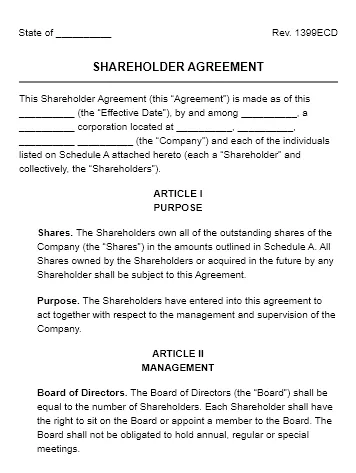
Stop searching and find out why people love the ease of creating beautiful and legally compliant Shareholder Agreement with PDFSimpli.

Pick from the colors and templates below
A shareholder agreement is an agreement made between the shareholders of a business that controls the relationship between them. Businesses with shareholders do not have to have a shareholder agreement and it is separate from the governing documents of the business (e.g. corporate bylaws). The constitutional documents manage the relationship between the shareholders and the business. So, the shareholders need a separate document to manage their relationships with each other.
This legal document typically is used to define the roles and responsibilities of the shareholders. A major element in a lot of shareholder agreements is to limit how and when a shareholder’s shares can be sold. This may be used to protect the interests of the business’s owners, especially minority shareholders. For example, a shareholder agreement may require unanimous consent or a supermajority to make certain decisions. This can help to prevent a single majority owner or a group of owners who form a simple majority from seizing complete control of the business.
Additionally, the document can be used to provide a structure for resolving a dispute between shareholders. Although it is not necessary for all organizations, a shareholder agreement may provide value even to a company with only two shareholders. Establishing how the shareholders will interact and what their responsibilities are in writing can be valuable in many situations.
The shareholders of a business may make a shareholder agreement as a preemptive measure to protect shareholders’ rights and help to ensure avoid serious conflicts. They may also consider entering into one as a temporary measure to set some rules for how they will proceed during a particularly challenging time period. For example, the shareholders may all agree not to sell their stocks in the company for a set time while the business undergoes some strategic changes. Alternatively, they may decide to require a supermajority on decisions such as selling the business or merging with another entity.
Having a shareholder agreement in place can be an intelligent way to ensure that the shareholders’ interests are protecting and that they share the same expectations for their rights and contributions. Even with only two shareholders, it is easy for a contentious decision to lead to problems. Well-thought-out rules can make a huge difference. It can prevent the majority owner from making unilateral decisions while also preventing a small minority owner from having excessive influence (such as blocking an otherwise unanimous decision).
Shareholder agreements can become quite complex depending on the terms included. Therefore, it is a good idea to work from a template. Doing so will help to sort out most of the legal language so you can focus on working out the important terms of the written agreement. A template may also inspire you to discuss some ideas that you may not have considered otherwise.
Unlike some other similar documents, a shareholder agreement is not required to run a business, even a corporation. Therefore, it can contain almost any terms that the parties consider important. Nonetheless, there are a few elements that are included in most shareholder agreements:
Many shareholder agreements are between all the shareholders of a company. However, this doesn’t have to be the case; it can be a subset. In either case, the shareholders should all be named. If it is a long-standing agreement, new parties can be added to the agreement in an attached schedule.
If there is an individual or group (such as a family or another business) that owns the majority, the agreement should define the majority shareholder and minority shareholder.
Include some details about what each shareholder is expected to do. This is sometimes broken down by category. Responsibilities may include involvement in certain aspects of the business.
The agreement should include some details about how shares in the business can be transferred. This may include limitations on when a shareholder can sell his or her ownership. It may also include a structure for what happens if the shareholder passes away.
You can set the rules for how dividends will be distributed. This may include who gets what and how the decision to distribute is made.
The agreement may also include rules for selling or dissolving the company. This often requires more than a simple majority vote.
The shareholder agreement will need to include details about all the involved shareholders. Additionally, it is easier to write if you have agreed in principle to the terms beforehand. So, spend some time preparing to write by gathering the necessary details about the company and its shareholders. Also, discuss the goals of the agreement with other shareholders.
Select what software you will use to write the agreement. As described above, it is easier if you start from a template. Consider using PDFSimpli. With a library of templates for shareholder agreements and other legal documents, you will have a strong starting point. You can also use the online editor to make changes from any device.
Once you have selected a template, open it in the editor and fill it out. Many of these elements of the shareholder agreement template are standard. However, you will need to define your own terms for other sections. You can add a company logo, diagrams, watermarks and more. Make sure to save to the cloud as you go.
This is a significant agreement that will play a big role in how your company owners interact. Therefore, it is important to thoroughly review the document before signing. Fortunately, you can do this easily in the editor. Alternatively, you can print watermarked copies for easy review on paper. This is very helpful for discussing the specifics of the agreement.
Finally, you are ready to sign the document. You do not have to get it notarized. So, you can easily sign online using PDFSimpli’s built-in signature functionality. Alternatively, you may print a final copy for everyone to sign. You can also save it or download it to print later.
Select Language





© 2026 , WorkSimpli Software, LLC. All rights reserved.