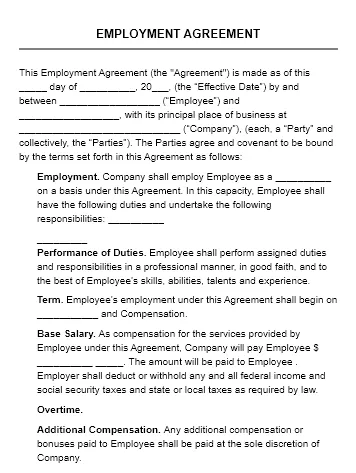
Employment Agreement Template
Stop searching and find out why people love the ease of creating beautiful and legally compliant Employment Agreement with PDFSimpli.
Stop searching and find out why people love the ease of creating beautiful and legally compliant Employment Agreement with PDFSimpli.

Pick from the colors and templates below
After a job candidate accepts a job offer, employers must draw up an employment contract that describes everyone’s obligations, rights and responsibilities as long as a relationship exists between employee and employer. With a proper contract, all parties understand their relationship and how to maintain it. General items that appear on most contracts include addresses and names of worker and employer, salary, salary schedule, job responsibilities and requirements, benefits, time off, job title and a confidentiality clause.
One major factor that determines what belongs on a contract is employment type. Permanent full-time employment means the worker meets the state’s full-time status requirements and does not have a predetermined employment end date. Permanent part-time employment workers work part time and do not have a predetermined employment end date. Fixed-term and fixed-period employment means that an employee has a predetermined employment end date. Also, neither party bears an obligation to give notice to end employment under fixed-term or -period employment.
Another employment classification is “contract employee.” This means a company hires a person for a specific project, but the business relationship and contract end along with the project. Contract employees receive a specific wage as long as they uphold their end of the agreement. Examples of contract employees include copywriters, landscapers, consultants and graphic artists.
Employment contracts help ensure employer and employee remain on the same page regarding job responsibilities, wages, employer/employee rights and benefits that companies offer. Even if a new hire understands her or his job duties and salary, an employer may create an employment agreement that includes a confidentiality agreement to protect company secrets or sensitive information. Employers who bring on interns or temporary employees should have them sign an agreement so everyone understands the nature of employment and how long the internship or temporary position lasts. Because oral agreements do not offer the same legal protections as written contracts, employers should use employment contracts that reiterate all terms and details of an oral agreement.
Without a proper employment agreement, workers and companies may have differing opinions about an employee’s job title and responsibilities, which can lead to confusion, frustration and potential legal action. Besides defining job roles, employment contracts also offer all parties legal protection under state employment law. For instance, contracts may explain how to resolve disputes, a specification that can save a lot of time and money. If over time, parties feel that an existing contract no longer serves them, they can renegotiate and sign a new agreement. Without a written contract, employers and employees may have no choice but to handle disputes in court, which could prove expensive and time-consuming.
The contents of an employment contract depend on the specific employment type. Some of the most common elements of an agreement include:
1 What is a Employment Contract?
2 What is a Employment Contract used for?
3 Why should you use a Employment Contract?
4 How to write a Employment Contract?
5 How to fill out a Employment Contract with PDFSimpli in five steps?
6 Employment Contract frequently asked questions
6.1 What is a probationary period?
6.2 What is the difference between an independent contractor and an employee?
6.3 What is a non-solicitation clause?
To further determine whether a new employee matches a business’s company culture, an employer may require that new hires complete a probationary period. Besides fitting in well with the company, this period lets business owners determine whether new team members possess the proper skills and education to fulfill their role. During the probationary period, employers reserve the right to terminate the employee without cause or offering severance pay. After the period ends and all parties agree to maintain their professional relationship, employees qualify for any benefits that the position offers. Successfully completing a probationary period also means that moving forward, the employer must have proper grounds to terminate an employee, give an employee notice of termination and offer severance pay to qualifying workers.
Also referred to as “contract employees,” independent contractors do not have the same rights as standard employees, nor do employers owe contractors the same obligations as they do employees. For instance, companies do not have to pay state or federal income taxes for contract employees. Employers may not have a say in when contractors perform their work, and companies do not have to provide contractors with tools to complete their duties.
Employees must often work during specific hours, and they usually have specific premises where they work. State law may determine how companies must pay employees.
Other than a non-compete clause, an employment agreement may include a non-solicitation clause. Such clauses prevent employees from persuading customers or other employees to work for or give their business to a competitor. Valid clauses must meet certain regulations and last for a specific time, such as two years from the end of employment termination.
Select Language





© 2026 , WorkSimpli Software, LLC. All rights reserved.